

×
Upgraded Linear Vibrating Screen with Silent Air Supply & Electric Heating, Stably Boosts Screening Capacity for Wet Materials
# Overcoming Mesh Blinding Issues with Damp Materials | Customized Linear Vibrating Screen Featuring Silent Airflow & Electric Heating for Stable, Continuous Production
In the powder and granular material screening industry, many manufacturers face significant challenges when screening damp raw materials. A process that appears routine
can quickly become a production bottleneck when dealing with materials that have high moisture content or adhesive properties. Initially, many clients focus solely on screening precision and throughput when
selecting standard vibrating screens, overlooking the material's physical characteristics. When the material is damp and sticky, a host of problems arise simultaneously, severely disrupting the factory's normal
production flow.
## Client Challenges
The client involved in this project required a grading and screening process for a batch of raw materials with significant moisture content. These materials were characterized by high moisture levels
and sticky particle surfaces, classifying them as difficult-to-screen, damp materials. Using conventional linear vibrating screens revealed critical issues that caused multiple disruptions to workshop operations.
The primary issue was **frequent mesh blinding and material adhesion**. As damp particles moved across the screen surface, they tended to clump together and adhere tightly to the inner walls of the mesh
openings. As screening progressed, wet material accumulated within the apertures, gradually filling and clogging the fine mesh. Once the mesh became blocked, material could not pass through effectively;
instead, material intended for separation would accumulate on the screen surface, leading to a cascade of secondary problems such as material spillage, reduced screening precision, and inconsistent product
quality.
Mesh blinding was not an isolated incident but a recurring problem. Once the mesh became clogged, normal screening operations were halted, forcing the production line to shut down so workers could
manually open the equipment and clear away the adhered, clumped wet material. Due to the strong adhesive nature of the damp material, simple air-blowing was insufficient for cleaning; instead, significant
time and labor were required to painstakingly peel away material stuck to the screen surface and inside the mesh openings. After cleaning and resuming production, the screen clogging issue inevitably recurs
after a short period of operation, trapping the process in a vicious cycle of "production — clogging — shutdown for cleaning — resuming production."
The primary direct consequence of frequent shutdowns for cleaning is a **sharp decline in production efficiency**. The production line operates as an integrated, continuous system; while upstream feeding and
conveying processes supply material steadily, downstream packaging and storage stages await the screened product. Repeated interruptions at the screening stage disrupt the rhythm of the entire line. Effective
production time is consumed by extensive maintenance downtime, preventing the equipment from achieving its theoretical throughput and causing actual capacity to fall far short of customer expectations.
This intensifies pressure regarding order delivery and makes it difficult to adhere to production schedules—issues that become particularly acute during peak production seasons.
Secondly, manual screen cleaning leads to **steadily rising labor costs**. Each clogging incident requires assigning operators to clear the screen, increasing the physical strain on the workforce. Cleaning
moist materials often results in scattered dust and clumps, creating a messy workshop environment; furthermore, the task of removing adhered material makes for a poor working experience. Frequent disassembly
and the practice of striking the screen to clear it accelerate wear and tear. As screens are consumable parts, such rough handling shortens their lifespan and drives up replacement costs, resulting in consistently
high long-term equipment maintenance expenses.
At the same time, screen clogging leads to **inconsistent screening quality**. When the screen is blocked, fine particles that should have passed through are instead discharged along with the coarse material.
This results in incomplete separation, significant fluctuations in particle size, and an unstable product pass rate. Inconsistent quality—specifically the risk of failing to meet particle size specifications—exposes
the company to customer returns and rework, directly damaging its product reputation and market credibility.
The customer has attempted various methods to alleviate the clogging problem, such as increasing the vibration motor's excitation force, installing bouncing ball cleaning devices, or slowing down the feed rate
to reduce the volume of material hitting the screen surface per unit of time. However, these measures offer only limited relief and fail to address the root cause of the issue. Simply increasing the excitation
force accelerates fatigue wear on the equipment frame and springs, thereby shortening the machine's overall service life. Bouncing balls are effective only for dry materials; when faced with moist, sticky materials
, they tend to adhere to the screen surface, rendering them ineffective at keeping the mesh clear. Reducing the feed rate lowers the frequency of mesh clogging but sacrifices production capacity, failing to meet
the customer's output requirements. Conventional solutions cannot fundamentally resolve the issues of mesh adhesion and clogging caused by the high moisture and stickiness of the raw materials.
The customer urgently required a customized screening solution that could reduce material stickiness at the source, eliminate the root causes of clogging, and enable continuous, uninterrupted production.
## Solution
After thoroughly analyzing the customer's on-site operating conditions, material characteristics, and production pain points, our technical team moved beyond standard linear vibrating screen designs.
We developed a specialized, customized solution to address the core problem of moist materials sticking to and clogging the mesh. Building upon a stainless steel linear vibrating screen, we integrated a **silent
air blower and electric heating unit** to create a combined hot-air system. This system reduces surface moisture and material adhesiveness at the source, effectively solving the clogging problem associated
with moist materials and meeting the customer's need for continuous production.
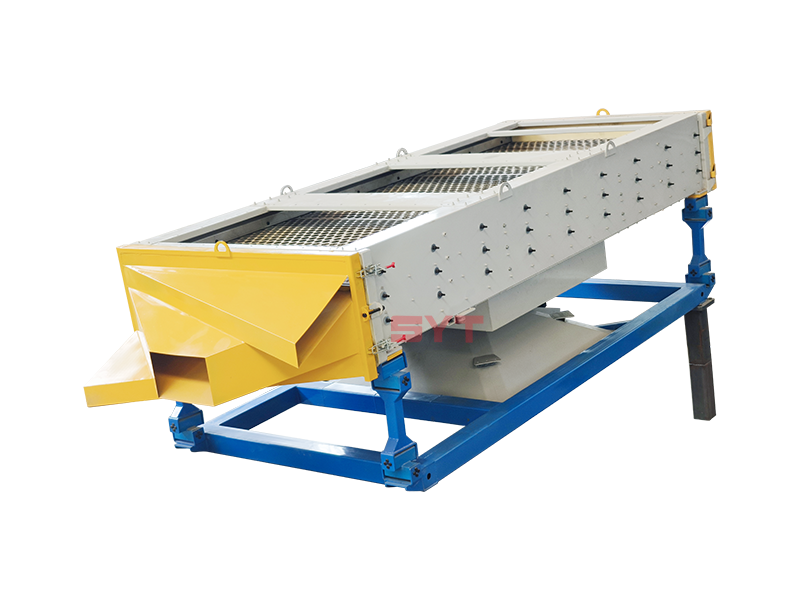
The customized screening system utilizes a linear vibrating screen as the primary unit, constructed entirely from stainless steel. All material-contact parts are made of corrosion-resistant, rust-proof stainless steel,
ensuring compliance with the customer's hygiene standards for raw material processing. The equipment features a robust frame structure, stable vibration, and consistent classification accuracy. The key upgrade
the integrated silent air blower and electric hot-air heating system; the entire assembly is combined with the screening unit in a compact layout that minimizes workshop space requirements. It is easy to install and
commission, allowing for direct integration with the customer's existing feeding and discharge production lines. The hot air system operates with a clear, logical workflow: the electric heating unit serves as the heat
source, where incoming air is evenly heated by electric heating elements to generate a stable, controllable stream of hot air. A dedicated quiet blower continuously delivers this heated air into the screening
chamber, allowing it to permeate the screen surface and make full contact with the moist material flowing across it. Throughout the screening and forward-conveying process, the hot air continuously removes
moisture from the material particles, lowering the surface moisture content and weakening the adhesive forces between particles and between the material and the screen mesh. This prevents the material from
clumping or sticking to the mesh openings, fundamentally eliminating the issue of mesh clogging caused by wet material, rather than relying merely on passive mechanical mesh-clearing mechanisms.
Regarding the system's detailed design, we have prioritized the workshop environment by selecting a **quiet blower**. Many standard hot air blowers generate excessive noise during operation; prolonged use
can lead to noise levels exceeding safety standards, degrading the working environment and potentially harming operator health. The quiet blower selected here features an optimized airflow structure and
vibration-dampening, noise-reducing design. It effectively controls operating noise while delivering a steady flow of hot air, ensuring no additional noise pollution is introduced to the workshop and meeting
requirements for safe, worker-friendly operations.
The electric heating unit supports temperature regulation, allowing customers to flexibly adjust the hot air temperature based on raw material characteristics and initial moisture content, thereby precisely
controlling the degree of drying and dehumidification. This temperature control capability is crucial: it removes excess surface moisture and reduces stickiness without overheating or damaging the material's
quality. By adapting to the specific physicochemical properties of the raw material, the system ensures the quality of the finished product remains intact after screening. The hot air is evenly distributed within
the screen box, preventing localized overheating or areas lacking airflow; the material remains in contact with the hot air throughout the entire vibration, conveyance, and classification process, ensuring consistent
and stable dehumidification.
The improvements delivered by this comprehensive solution are far-reaching. The most immediate and noticeable benefit is the **virtual elimination of mesh clogging and material adhesion issues**. After
undergoing hot-air dehumidification, the material's surface tackiness is significantly reduced, and particle dispersibility improves. As the material moves forward across the vibrating screen surface, it passes
the mesh smoothly for classification; the mesh openings are not easily clogged by the material, eliminating frequent shutdowns caused by screen blinding. Consequently, the production line maintains continuous
operation over long periods without repeated interruptions.
Production efficiency is significantly boosted. The equipment can be fed at its designed rated capacity without the need to deliberately slow down the feed rate to prevent clogging, allowing the equipment's full
capacity to be realized and effective production time to increase substantially. This leads to a direct increase in the entire line's output, enabling customers to easily meet production schedules and ensure on-time
order delivery.
Manual maintenance and operation costs are significantly reduced. Workers no longer need to frequently stop the machine or disassemble equipment to clean the screen, which greatly alleviates labor intensity
and reduces manpower requirements. The screen is spared the wear and tear associated with adhering material and frequent disassembly, extending its service life and lengthening the replacement cycle for spare
parts, thereby lowering long-term maintenance material costs. Additionally, the workshop environment improves; there is less need to clean up scattered, clumped, or wet material, resulting in a tidier site.
The quality of the screened product is more consistent. Good material dispersion and smooth passage through the mesh ensure stable classification results and minimal fluctuation in particle size specifications.
This guarantees a high product pass rate, reduces the risks of rework and returns, and safeguards the customer's market reputation. The system features an integrated design where the hot-air system and vibrating
screen are mounted on a single base. This ensures a robust structure and optimized vibration damping, resulting in smooth operation, minimal vibration, and a low failure rate. Maintenance is straightforward, and
the learning curve is gentle—workers can master operations with simple training. Centralized control of temperature and fan start/stop functions makes operation convenient.
This customized linear vibrating screen solution, equipped with a hot-air dehumidification system, is not merely a standard screen fitted with add-on accessories; rather, it is a comprehensive system solution
specifically designed for the screening of moist, sticky materials. Unlike traditional passive mesh-cleaning methods—such as using bouncing balls, brushes, or ultrasonic systems—this solution actively reduces
material moisture and stickiness, addressing the root cause of mesh clogging. It is particularly well-suited for the classification and screening of granular and powdered raw materials that have high moisture
content and a tendency to stick to the mesh or form clumps.
We offer flexible customization to meet the specific needs of different clients. By adjusting parameters such as hot air temperature, airflow volume, and fan power based on factors like material type, incoming
moisture content, target throughput, workshop space, and explosion-proof requirements, we tailor equipment specifications to the application. Whether dealing with screening challenges involving moist
materials—such as food ingredients, chemical powders, mineral granules, or various agricultural products—we leverage years of R&D and manufacturing expertise to provide bespoke solutions. We help resolve
production pain points like mesh clogging, insufficient capacity, and inconsistent quality, thereby enabling stable, efficient production and helping clients reduce costs while boosting productivity.
In the material screening industry, material characteristics vary widely, and there is no "one-size-fits-all" standard screening machine. Screening difficult materials requires a deep understanding of specific
challenges and the customization of equipment structures and auxiliary systems. The custom linear vibrating screen we recently delivered—featuring a quiet air blower and an electric heating unit—is a successful
example of a solution designed to tackle moisture-induced mesh clogging. If you are facing issues with screening moist or sticky materials—such as frequent downtime due to clogging or an inability to meet
production targets—we invite you to discuss your material parameters and operational conditions with us. Our technical team will design a tailored screening solution to help you overcome production bottlenecks
and achieve continuous, stable screening operations.